My research addresses fundamental questions about gravity, quantum physics, and cosmology, with a particular interest in understanding gravitational entropy, contributing to the loop quantization program, and finding innovative connections between theory and experiments.
Black holes · Thermodynamics · Gravitational waves · Gravitational Entropy
The maximum entropy puzzle for black hole mergers
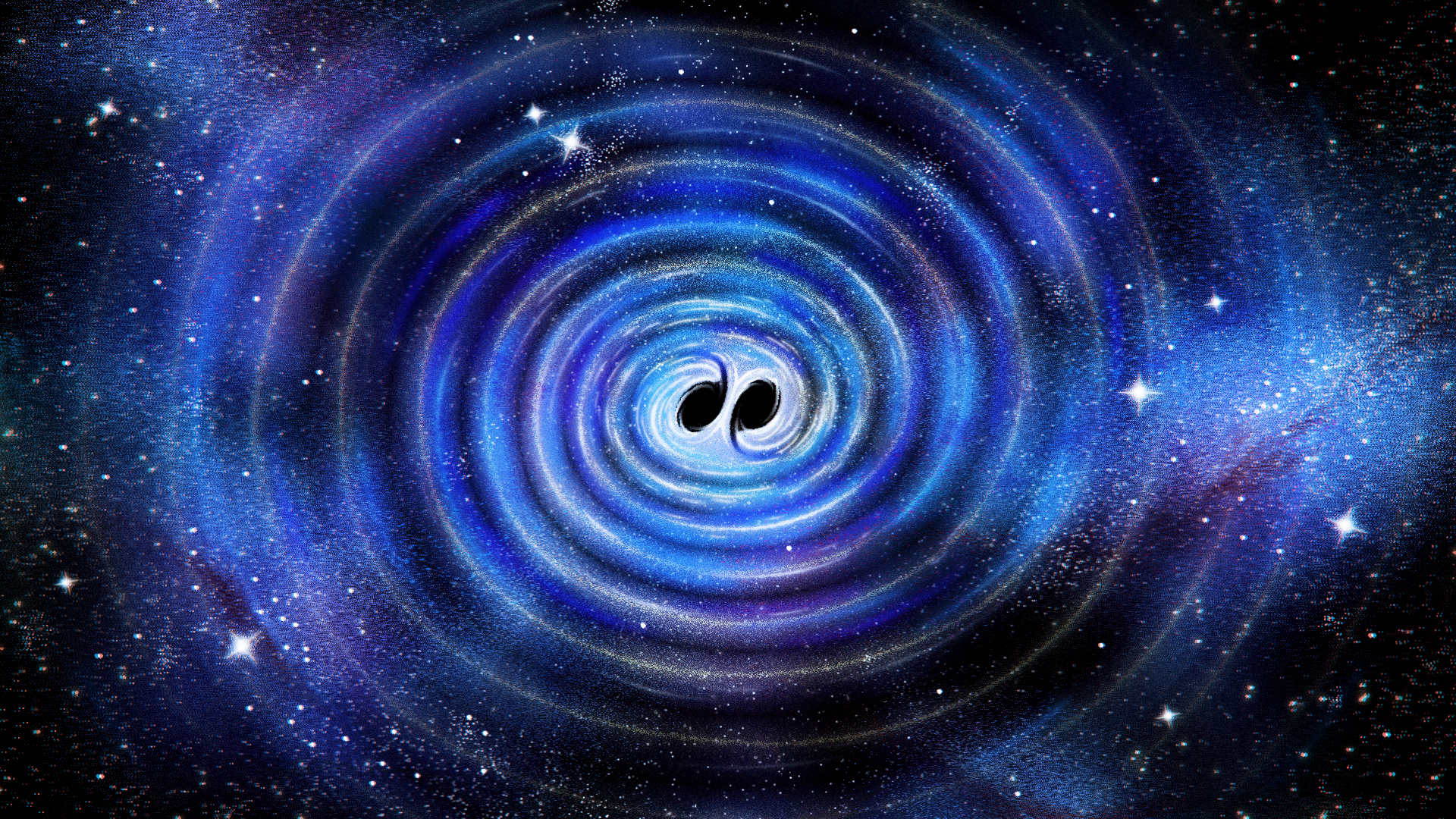
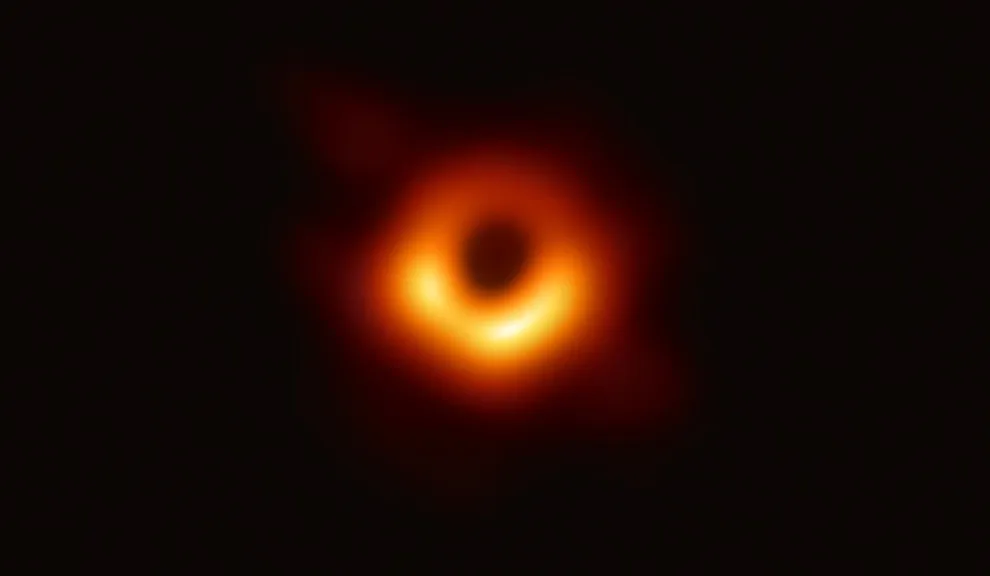
Can a simple thermodynamic principle help predict the final state of a binary black hole merger? In my first-author Physical Review Letters paper, we investigated whether entropy maximization could explain the mass and spin of the remnant.
Using post-Newtonian relations between the energy and angular momentum of a binary black hole system, we mapped the evolving binary to a sequence of hypothetical remnant Kerr black holes. Since the post-Newtonian expressions don't have a natural stopping point, we would not expect to be able to use them to predict the properties of the remnant. However, we observed that there is a Kerr solution in the sequence of hypothetical remnants with a maximum entropy, and this solution possesses mass and spin values remarkably close to those of the remnant predicted by numerical relativity (with agreement within a few percent). Alternatively, using numerical relativity simulations, we construct this same mapping to the space of Kerr solutions by computing the system’s Bondi mass and angular momentum from the energy and angular momentum carried away by gravitational waves, obtaining consistent results. This unexpected finding motivated us to conjecture that general relativity selects the solution that maximizes the entropy of the system, subject to balance laws. Beyond our conjecture, we see this result as a maximum entropy puzzle for binary black hole mergers, which offers new insights and raises new questions about the meaning of entropy for the binary system and the validity of the maximum entropy principle beyond standard thermodynamics.
Maximum Entropy Conjecture for Black Hole Mergers
Monica Rincon-Ramirez, Nathan K. Johnson-McDaniel, Eugenio Bianchi, Ish Gupta, Vaishak Prasad, and B. S. Sathyaprakash.
Physical Review Letters 137, 021406 (2026).
Do black hole mergers maximize entropy?
Vaishak Prasad, Monica Rincon-Ramirez, Nathan K. Johnson-McDaniel, Eugenio Bianchi, Ish Gupta, and B. S. Sathyaprakash.
International Journal of Modern Physics D (2026).
Our collaborative essay received an Honorable Mention in the Gravity Research Foundation’s 2026 Essay Competition.
Research in the media




Quantum geometry · Spinfoams · Inflation · Primordial gravitational waves · CMB Polarization
Probing the Immirzi parameter through primordial gravitational waves
During my doctorate, under the supervision of Prof. Eugenio Bianchi, I studied effective quantum corrections to gravitational phenomena arising from the spinfoam approach to quantum gravity. In spinfoams and loop quantum gravity, the coupling constant known as the Barbero–Immirzi parameter (γ) sets the typical scale of the spectrum of geometric observables, such as the volume and area of a quantum chunk of space. Our work provided further support for the interpretation of γ as a measure of gravitational parity violation. By constructing a one-parameter family of effective field-theory actions for cosmic inflation with varying degrees of parity violation, we showed that, if the level of asymmetry of the EPRL spinfoam model persists from the quantum-gravity regime into the inflationary era, the measurement of three cosmological parameters (primordial gravitational-wave polarization, tensor tilt, and the tensor-to-scalar ratio) could constrain the Barbero–Immirzi parameter, and therefore, the scale of discreteness of the quantum geometry of space.
Spinfoams, γ-duality, and parity violation in primordial gravitational waves
Eugenio Bianchi and Monica Rincon-Ramirez.
Physical Review D 113, 124013 (2026).
γ-Duality and Primordial Cosmology: Measuring the Quantum Geometry of Space
The Pennsylvania State University, Eberly College of Science.